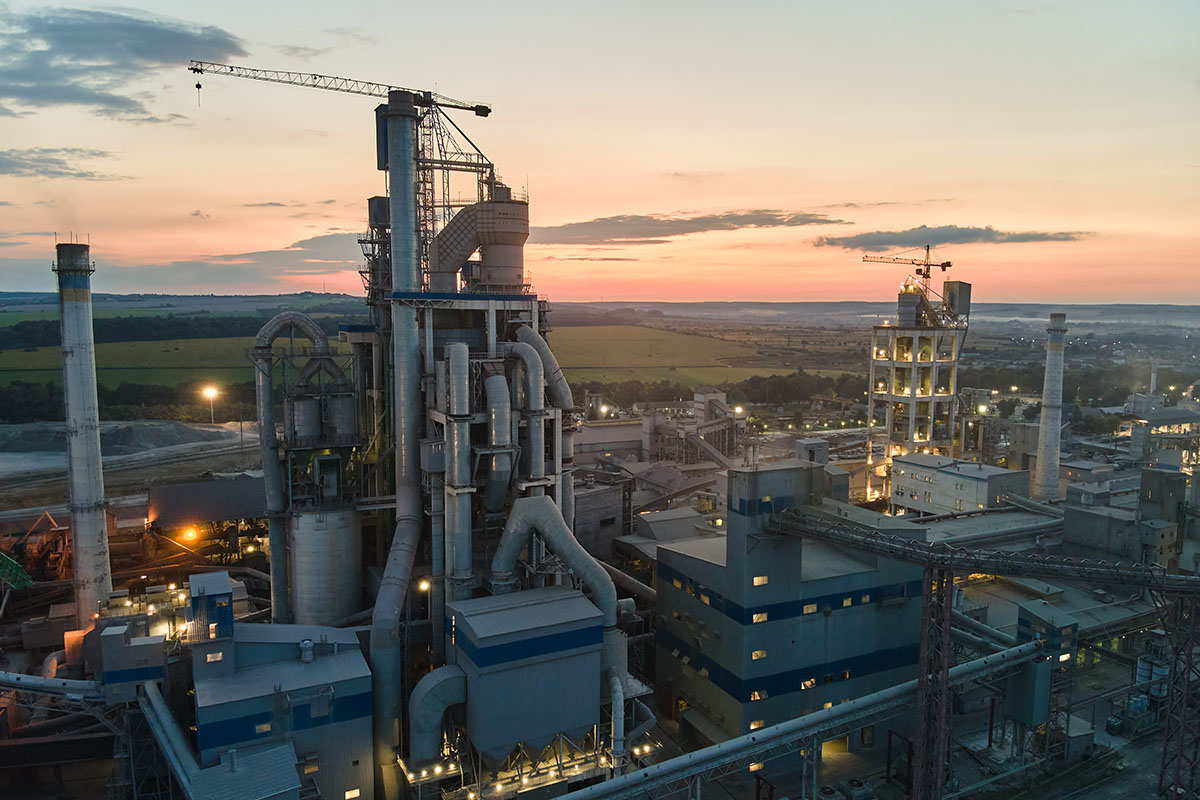
Heidelberg Materials has paused GeZero, the €191 million EU-backed project meant to make Geseke Germany's first cement plant to capture all its CO2. The capture plant was due years before the pipeline and storage it depends on, and no one is underwriting the risk of a finished plant with nowhere to send its carbon.
Key Takeaways
Carbon capture for cement is usually discussed as an engineering problem: can a kiln be redesigned to concentrate its CO2, and can the gas be captured cheaply enough? Last week one of the industry's leading pioneers showed that the harder problem sits outside the plant fence. Heidelberg Materials, which already runs a full-scale capture plant in Norway, has paused its flagship German project, not because the technology failed but because the pipes, ships and storage sites it depends on will not be ready in time, and no one has agreed to carry the risk of that gap.
In an October 22 statement, Heidelberg Materials said it is pausing the GeZero project at its Geseke plant in its current form and will further optimize the design. The company said current framework conditions are not yet sufficient for a viable business case, and that the value chains for CO2 transport and storage are not mature enough to provide solutions in time at an economic risk it considers acceptable as a CO2 producer. Cement production at Geseke continues, and Christoph Streicher, General Manager Germany, said the site "remains of great importance" to the company.
The project was meant to be a template. When the company announced its EU Innovation Fund grant in December 2023, it described a €191 million award for a new oxyfuel kiln and capture plant that would make Geseke Germany's first fully decarbonized cement plant, capturing about 700,000 tonnes of CO2 a year from 2029. Construction was to begin in 2026. The CO2 would travel by train to a Wintershall Dea hub and on to storage under the North Sea, with rail explicitly described as a bridge until pipeline infrastructure became available. Chief Sustainability Officer Nicola Kimm said the grant "demonstrates the relevance of GeZero for the decarbonisation of our sector."
The warning signs were visible well before last week. In July 2025, Bloomberg reported that Heidelberg had stopped giving a construction timeline because the conditions for a final investment decision were not in place, as a draft German budget proposed cutting a clean industry programme to €1.8 billion from €24.5 billion over the medium term. The same report noted that ArcelorMittal would hand back a €1.3 billion subsidy for green steel units, citing weak demand, policy and power prices.
The detail behind the pause is a timing mismatch. According to an analysis by CleanThinking, Open Grid Europe's Delta Rhine Corridor, the pipeline intended to carry CO2 from North Rhine-Westphalia to the Dutch border, is expected from 2033 at the earliest, as part of a planned national network of about 1,000 kilometres. That is roughly four years after Geseke was due to start capturing. The same analysis cites the Geostor research project estimating suitable storage under the German North Sea at 0.5 to 1.5 billion tonnes of CO2, down from up to 6 billion tonnes two years earlier, as wind farms, shipping lanes and protected areas compete for the same seabed. Onshore storage remains banned under Germany's new CO2 storage law unless a federal state explicitly opts in.
The economics are just as stretched. CleanThinking puts CCS costs at €150 to €250 per tonne of CO2, against an EU emissions trading price of about €74. Germany's climate protection contracts are designed to bridge that kind of gap for 15 years, and since the 2026 round companies can withdraw before operations begin if critical external conditions fail to materialize. But payments only begin once a plant actually saves CO2. That leaves the scenario Heidelberg fears uncovered: a finished capture plant with no pipeline or storage to receive its output. The company is now calling for a state-supported risk-mitigation mechanism for pioneers, since CCS depends on infrastructure that involves several market players, and says onshore storage could lower costs for inland sites like Geseke.
The stakes extend beyond one plant. In reports released ahead of COP31, UN Climate Change found that current national pledges would cut global emissions by only about 6 percent by 2035 compared with 2019, and Executive Secretary Simon Stiell said collective progress "remains clearly insufficient." Cement is among the sectors where process emissions cannot be removed by clean power alone, so delays in capture projects feed directly into the gap between targets and delivery.
Heidelberg is not abandoning carbon capture. It has operated the world's first industrial-scale CCS plant in cement at Brevik, Norway, since June 2025, and took a final investment decision on its Padeswood project in the UK in September 2025. It says it will first build the projects where a business case exists. The lesson for everyone else is that a capture project is really a chain of commitments between an emitter, a transport operator, a storage operator and the state, and the weakest link sets the timetable. A grant tied to one link does not de-risk the others, and an emitter cannot sign an offtake or storage agreement with infrastructure that does not yet exist.
For companies with hard-to-abate emissions, their customers, and the public bodies funding them, the playbook looks like this:
GeZero was supposed to show that a German cement plant could capture all of its CO2. For now it shows something more useful for anyone planning a decarbonization project that depends on shared infrastructure: the capture plant is the part a company controls, and the part that decides the schedule is everything that comes after it.


Report
GeZero stalled because no agreement covered a capture plant left waiting on someone else's pipeline. This report looks at how legal operations teams are taking on that kind of cross-party commercial risk before it reaches the balance sheet.
Download

Guide
For builders and developers, cement is often among the largest Scope 3 sources, and a delayed capture plant pushes back the reductions they planned on. This guide covers measuring those emissions and choosing reduction levers that do not hinge on one supplier's timetable.
Download
Report
A €191 million award now sits behind a paused project. This report examines how public funders manage grants and track milestones, and where their systems fall short when a funded project depends on infrastructure outside the grant agreement.
Download
Budderfly has committed $500 million to fund energy upgrades for small and midsize US cities, repaid from savings instead of debt. The model removes the upfront cost, but moves the risk into 15-year contracts few councils are equipped to police.
FEMA resilience grants dropped from $3.3 billion in 2022 to $726 million in 2025. The bill for flood and storm defenses is moving to states, cities and the businesses that depend on them.
