A key Rhine gauge fell to its lowest reading since 1880 and barges ran restricted for 74 days. English courts are signaling that weather this predictable may not count as force majeure, which leaves the bill with whoever signed the contract.
Key Takeaways
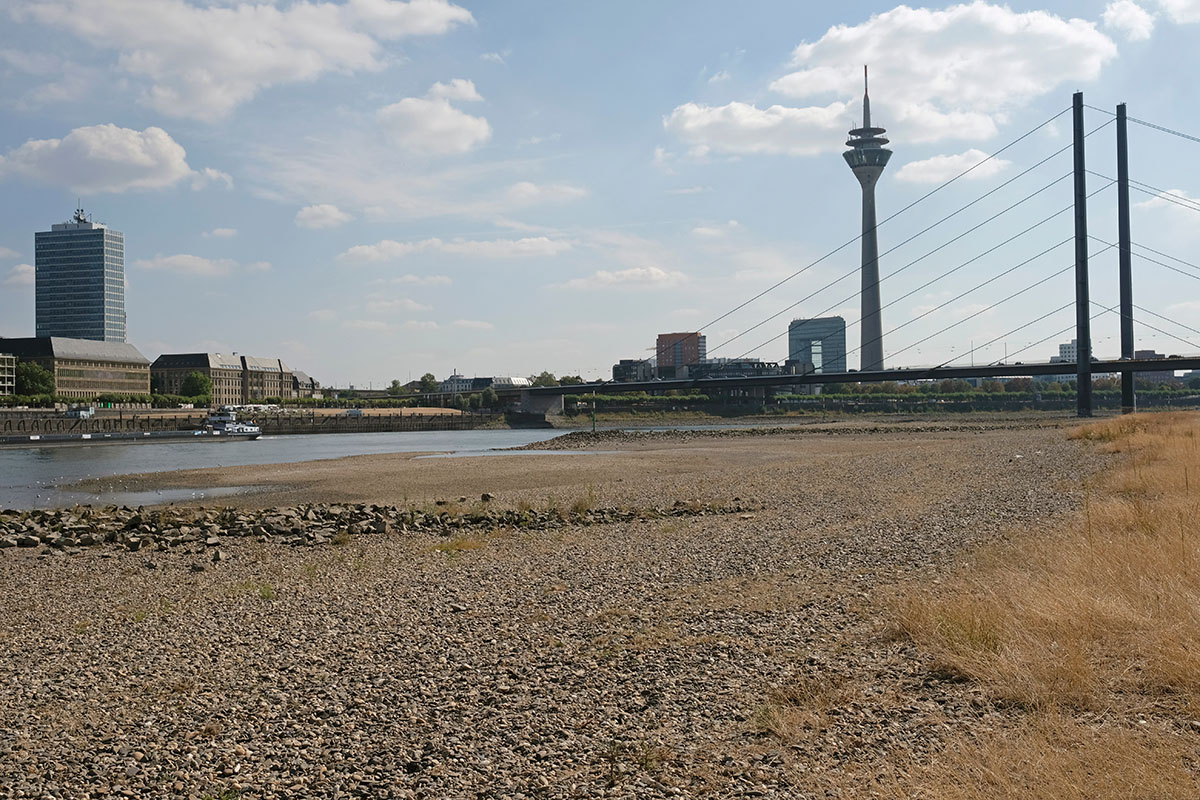
For most of this year, the busiest inland waterway in Europe has been closed to anything but light loads. Barges on the Rhine have sailed a fraction full or not at all, and the cost of that has to land somewhere. Under most supply contracts, the party that cannot deliver reaches for the force majeure clause. The problem is that courts are increasingly asking a question those clauses were never drafted to answer: can a drought you saw coming really count as an act of God?
The numbers from the Rhine are stark. The gauge at Kaub, the reference point for barge loading on the middle river, read 4 cm on September 24, the lowest since records began in 1880, according to the Ti Insight Global Supply Chain Risk Monitor for October. It sat below 78 cm, the level at which barges must sharply cut loads, for 74 days this year. The previous record was 41 days, set in 2022. By August only small vessels, or vessels loaded to about a fifth of capacity, could pass the middle and upper river, and voyages to southern Germany and Switzerland had virtually stopped. World Weather Attribution found climate change made this summer's extreme evaporation in western Europe about 80 times more likely.
The Rhine is not an isolated case. The same monitor reports that the Panama Canal cut daily transits from 36 to 32 during what should be its rainy season, removing roughly two million tonnes of capacity a month, after the canal authority had expected no restrictions as late as May. A run of typhoons left container waits of six to 12 days at Chinese ports, with DHL Forwarding estimating congestion is absorbing 12 percent of effective vessel capacity. Costs are already moving: in the CIPS Global Pulse Survey for the third quarter, 36 percent of respondents predicted price increases for shipping and logistics, and one respondent cited weather conditions pushing up the price and quality of vegetables.
None of this arrived without warning. Low water on the Rhine set a record four years ago, and each season since has been forecast, modeled and discussed in boardrooms. That paper trail is now the problem.
A September analysis from law firm Ashurst points to a 2026 Commercial Court decision, ADM Industries Centers Ltd v Inerco Trade SA, which read "unforeseeable" in a force majeure clause as covering an event whose probability at signing was negligible, meaning so small that in commercial terms it could be disregarded. The court's own illustration was that bad weather may be foreseeable while three days of hurricanes may not be. Foreseeability is a matter of degree, and the degree is shifting. The same analysis cites the Court of Appeal's 2024 ruling in Sherman v Reader Offers, which held that unusual ice conditions were not unforeseeable because their unpredictability was itself foreseeable.
Companies are building the evidence against themselves in their own filings. Ashurst counts fewer than 200 references to "extreme weather" in UK annual financial reports in 2020 and more than 700 a year from 2022, and cites Financial Times reporting that about one in 10 recent earnings calls by large European companies mentioned extreme heat, drought or wildfire. It also notes that the World Economic Forum's Global Risks Report 2026 ranked extreme weather the most severe long-term risk. A company that warns investors about drought every quarter will struggle to tell a counterparty that a drought was beyond contemplation.
Wording matters as much as foreseeability. Writing in Food Manufacture, James Crayton, head of manufacturing at Walker Morris, notes that force majeure is not a standalone legal doctrine under English law, so protection depends entirely on what the clause says. Increased cost alone is generally not enough to trigger it, and English courts tend to enforce the risk allocation the parties agreed rather than rescue one side from a costlier bargain. A shipper paying three times the freight rate to move goods by rail because barges cannot float may simply be performing a bad deal.
Most organizations are not set up to reprice this exposure quickly. A survey of 425 supply chain professionals by ISM and Amazon Business found that 71 percent say balancing cost and risk now drives procurement strategy, yet only 45 percent say their organization is prepared for disruption and 65 percent still rely on manual reporting to gather supply chain data. That gap matters for contracts: a company that cannot see which suppliers depend on a single river, canal or port cannot know which clauses will be tested next.
The outlook offers little relief. Ashurst notes forecasts for a 2026 to 2027 super El Niño that could bring a stormy autumn to northwestern Europe and more heatwaves in 2027, and that PERILS put initial insured losses from severe convective storms across Germany, France, Switzerland and Italy in a single July week at EUR 2,186 million. For sustainability teams, this is where physical climate risk stops being a disclosure line and becomes a margin line. The leaders are treating contract terms as a climate adaptation tool:
The Rhine will rise again with the winter rains. The contracts signed this year will still be in force when it falls next summer. Companies that rewrite them now, while the record is fresh, are deciding in advance who pays. Those that wait will let a court decide whether a forecast drought was ever a surprise at all.


Report
Weather shocks and tariff shocks test contracts the same way: someone has to find every affected clause fast. This report shows how enterprises identify exposure, enforce protective terms and renegotiate before costs hit the bottom line.
Download

Guide
Contracts increasingly require suppliers to keep business continuity plans current. This guide covers the communication systems, situational awareness tools and response protocols that keep operations running when weather strikes.
Download

Report
With 65 percent of organizations still gathering supply chain data by hand, single points of failure stay hidden until a river runs dry. See how leading companies are moving to continuous, data-driven supplier monitoring.
Download
Capgemini's new survey finds 87 percent of large organizations have had climate-related supply chain disruption, yet just 15 percent have fully quantified the financial hit. The gap between spending and measurement is now the risk.
NHTSA's final rule cuts the 2031 fleet target to 34.9 mpg and projects 4.6 percent more gasoline burned through 2050. For automakers, that fuel shows up in Scope 3, which California requires them to report starting in 2027.
