Brussels narrowed its due diligence law to the very largest companies. Its Forced Labour Regulation has no size threshold, reaches every tier of the supply chain, and applies from December 2027.
Key Takeaways
When the EU's Omnibus I package rewrote the Corporate Sustainability Due Diligence Directive this year, a lot of mid-sized companies quietly took supply chain human rights work off their priority list. That reading was understandable, and it is dangerously incomplete. A separate law, the Forced Labour Regulation, sits alongside the directive with none of its new carve-outs. It has no employee threshold, no turnover threshold and no tier limit, and it starts biting in a little over fourteen months. Law firms have spent September telling clients the same thing: the product ban is coming, and it does not care how big you are.
The Omnibus changes to the due diligence directive were substantial. According to Norton Rose Fulbright, the directive now applies to EU companies with more than 5,000 employees and net worldwide turnover above €1.5 billion, and to non-EU companies with more than €1.5 billion of turnover inside the EU. Member States have until July 26, 2028 to transpose it, and most obligations apply from July 26, 2029. The amendments also deleted the requirement to adopt climate transition plans and steered companies toward the adverse impacts that are most likely and most severe.
The Forced Labour Regulation works on a different logic entirely. It is a market access rule, not a governance duty. From December 14, 2027, it applies to all economic operators placing or making products available on the EU market, or exporting them, regardless of company size, and it covers products made wholly or partly with forced labor at any extraction, production or manufacturing stage, according to a September 15 compliance roadmap from Mayer Brown. The European Commission puts it plainly: from that date, no product made with forced labour may be sold in or exported from the EU market. It estimates that 27.6 million people worldwide are in situations of forced labour, drawing on 2022 data from the ILO, Walk Free and the IOM.
The practical consequence is a mismatch. A manufacturer with 1,200 employees may now sit comfortably outside the due diligence directive and still face an investigation into a single component three tiers down its supply chain. The directive shrank. The product ban never had a floor to raise.
The regulation is enforced product by product. Under the Mayer Brown analysis, the lead competent authority can request information with a 30 working day response window in the preliminary phase, open formal investigations with response periods of 30 to 60 working days, and issue prohibitions with EU-wide effect that require products to be withdrawn, disposed of or delisted online. The authority carries the burden of establishing both the forced labor and its link to the product, but it can rely on direct, indirect and circumstantial evidence, including worker testimony, audit materials and geolocation data.
The Commission's guidelines, summarized by Covington & Burling, show how far that reach extends. Investigations may cover parts, components or entire products, intermediate or final goods, and whole product series or categories. The Commission itself acts as lead authority where the suspected forced labor takes place outside the EU. The guidelines also lay out a five-step penalty methodology whose illustrative models range from 0% to 4% of an operator's annual global turnover, depending on the severity and duration of the violation.
The national penalty rules are not far off either. Member States must adopt their rules on financial penalties and notify them to the Commission by December 14, 2026, according to Sidley Austin, and a public complaints portal opens on the day the regulation applies. A forced labor risk database identifying elevated-risk products, sectors and geographies is still under development, which means companies cannot yet lean on an official list to tell them where to look.
Here is the subtle part. Under the regulation, due diligence itself is voluntary. The guidelines recommend a six-step framework drawn from OECD guidance, tailored to the forced labor context, but no company is fined simply for lacking one. What gets punished is the product. That makes due diligence the only practical defense: a company that cannot show where its inputs came from has nothing to put in front of an investigator during a 30 working day information request.
Brussels is signalling where it expects the pressure to land. The Commission is running webinars through November, including sector sessions for solar, textiles, electronics, agri-food, automotive and fisheries, and it has put out a tender, closing September 28, for pilot contracts on supply chain traceability and risk detection. Those are the categories where component-level evidence will matter first, and where suppliers of every size will be asked to produce it.

Webinar
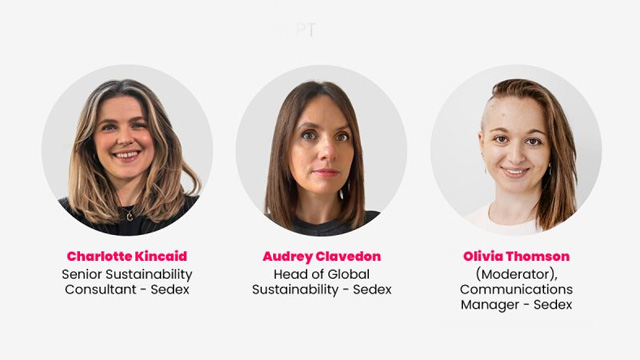
The Omnibus narrowed who must report and run due diligence, but it did not narrow the forced labor ban. Sedex experts unpack what the Omnibus changes for supply chain sustainability and why preparing now beats waiting for the deadline.
Watch

Guide
A product ban that applies at any stage of production turns supplier-site risk into your own compliance exposure. This framework covers identifying, assessing and reducing those risks across complex global operations and supply chains.
Download

Guide
Automotive is one of the sectors the Commission is training first, and its multi-tier supplier base is where forced labor clauses have to be enforced. This guide shows how contract intelligence helps manufacturers manage supplier risk across those agreements.
Download
Brussels wants at least 30% of every public tender scored on quality, including environmental and social impact. For suppliers chasing a €2.5 trillion market, sustainability data is about to become bid-winning evidence.

New governance data finds only 12% of S&P 500 board directors hold substantive sustainability expertise, despite surging shareholder and regulatory pressure.
Over 3,000 non-EU companies face CSRD obligations. The advisors guiding the largest transitions explain where U.S. companies consistently stumble.
